7 Beginner Surf Mistakes to Avoid in Arugam Bay
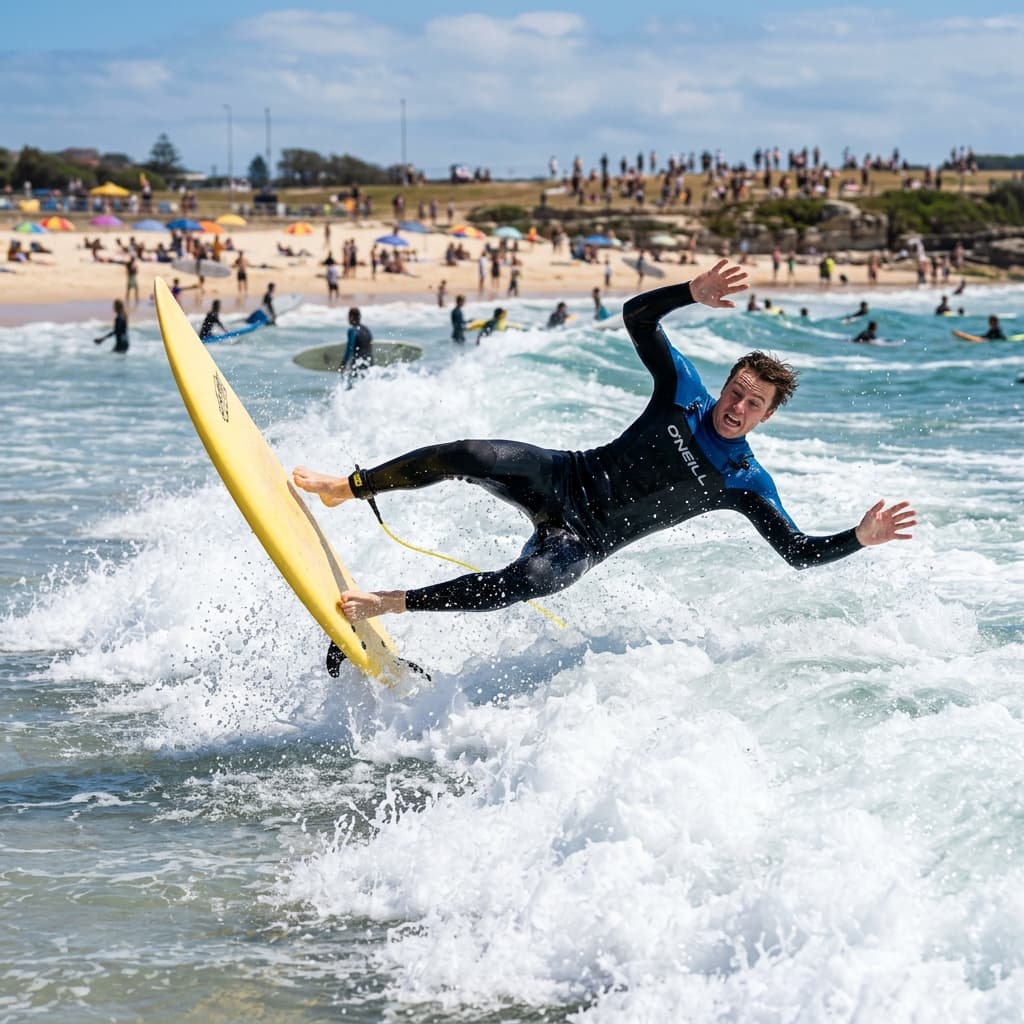
7 Costly Beginner Surf Mistakes to Avoid (And How to Fix Them)
Learning to surf is an incredibly humbling experience. You are dealing with an unstable surfboard on top of a constantly shifting, powerful body of water. No one gets it right on the first try.
However, many beginners spend weeks struggling to catch waves simply because they repeat the exact same mechanical errors without realizing it. When you book a lesson with Edgeway Surf's expert instructors, their primary job is to diagnose and correct these bad habits instantly.
To help you fast-track your progression before you even paddle out into the ocean, here are the 7 most common beginner surf mistakes to avoid and exactly how to fix them.
Mistake 1: Using a Board That is Too Small
This is the number one ambition-killer in surfing. Many beginners want to look "cool" and immediately attempt to learn on a high-performance 6-foot shortboard they saw in a surf movie.
Why it's a mistake: Shortboards lack "volume" (buoyancy). When you lie on them, they sink deep into the water. This creates massive drag, meaning you cannot paddle fast enough to catch the wave. If you do manage to catch it, the board is agonizingly unstable, and you will wipe out instantly. The Fix: Swallow your pride and ride a foamie (soft-top). Your first board should ideally be 8 to 9 feet long with over 75 liters of volume. You want maximum stability so you can focus entirely on your pop-up mechanics. Read our Beginner Surfboard Guide to understand exactly what you need.
Mistake 2: Paddling Too Far Back on the Board
When you lie down to paddle, board positioning is critical. Many beginners are terrified of "pearling" (when the nose of the board dives underwater), so they intentionally slide far back toward the tail.
Why it's a mistake: While the nose of the board is definitely pointing up into the air, the tail of your board is acting like a giant anchor dragging underwater. You will expend enormous amounts of energy paddling but go absolutely nowhere. The Fix: You must find the "sweet spot." The nose of the surfboard should be hovering precisely one or two inches above the water level. If it sinks, you are too far forward. If it sticks high up, you are too far back.
Mistake 3: Looking Down During the Pop-Up
Where your head looks, your body follows. When the wave picks you up and you begin the physical motion of the pop-up, you will naturally want to stare down at your hands or feet to make sure they are in the right place.
Why it's a mistake: A surfboard responds instantly to weight distribution. A human head is incredibly heavy. The moment you look straight down at the nose of your board, your weight shifts violently forward, and you will bury the nose into the water (pearling) and wipe out spectacularly. The Fix: Keep your chin up! Stare straight ahead at the beach or look down the line of the wave over your shoulder. Trust that your feet know where to land based on the muscle memory you practiced during your first surf lesson on the sand.
Mistake 4: Trying to Stand Up on Your Knees First
The "pop-up" requires explosive core strength. Many adults struggle with this motion initially and try to cheat by first kneeling on the board, and then stepping up onto their feet one leg at a time.
Why it's a mistake: The surfboard is highly sensitive. The moment you drop weight onto your knees, the board becomes brutally unstable. Even worse, stepping up slowly from your knees stalls the momentum of the board. You will lose the speed of the wave and fall backward. The Fix: You must commit to the actual pop-up. Keep your toes tucked against the deck pad, push up violently with your hands (like an explosive pushup), pull your knees straight to your chest, and rotate your hips. Practice this on land 50 times before you enter the water.
Mistake 5: Paddling with Bent Arms
When you first start paddling, you might try to "claw" at the water using bent elbows, trying to paddle as quickly as possible.
Why it's a mistake: Rapid, shallow, bent-arm paddling provides almost zero propulsion and will exhaust your shoulder muscles within 10 minutes. The Fix: Paddle like a freestyle swimmer. Reach your arm far forward, dig deep into the water, pull straight down alongside the rail of the surfboard, and push all the way through past your hips. You want deep, powerful, methodical strokes rather than rapid frantic splashing.
Mistake 6: Gripping the Rails During the Pop-Up
When transitioning from lying down to standing, many people instinctively wrap their hands around the sides (the rails) of the surfboard to gain leverage for the pushup.
Why it's a mistake: First, grabbing the rails destabilizes the board; if you push harder with your left hand, the board rolls left and you fall. Second, placing your hands on the curved edges means your hands will often slip right off the wet fiberglass. The Fix: Your palms must be planted completely flat on the top deck of the surfboard, positioned directly under your lower chest (near the bottom ribs). This forces the board straight down into the water evenly, providing a perfectly stable platform to jump from.
Mistake 7: Choosing the Wrong Surf Spot
Trying to learn how to surf at "Main Point" in Arugam Bay during the peak swell of August is a guaranteed disaster. The waves are too fast, the reef is sharp, and the crowds are entirely unforgiving.
Why it's a mistake: You will put yourself and others in danger, and you will leave frustrated without catching a single wave. The Fix: Know your level and choose the correct location. In Arugam Bay, beginners should exclusively surf at the inside sections of Peanut Farm, Baby Point, or Whisky Point, where the waves are perfectly tailored for learning.
Accelerate Your Learning
Identifying these mistakes is easy, but physically un-learning them when you are out in the ocean is difficult. That is why having a professional coach by your side is vital.
Stop struggling and start surfing! Book a lesson with our ISA-certified coaches to avoid these costly habits from day one:
- Beginner Surf Lessons: Perfect for first-timers, in a safe group environment.
- Private Surf Lessons: Fast-track your learning with 1-on-1 personalized coaching.
- Group Surf Lessons: Learn with friends or make new ones in a fun, social setting.
Frequently Asked Questions
Why do I always nosedive (pearl) when catching a wave?
Nosediving or pearling usually happens for two reasons: either you are positioned too far forward on your surfboard while paddling, or you are looking straight down at the nose of the board during your pop-up, which throws your heavy bodyweight forward.
Should beginners start surfing on a shortboard?
Absolutely not. This is a crucial mistake. Beginners must start on a large foam surfboard (8 to 9 feet) which provides the necessary buoyancy and stability required to catch waves and master the pop-up technique.