Arugam Bay Surf School vs. DIY Surfing: What's Better for 2027?
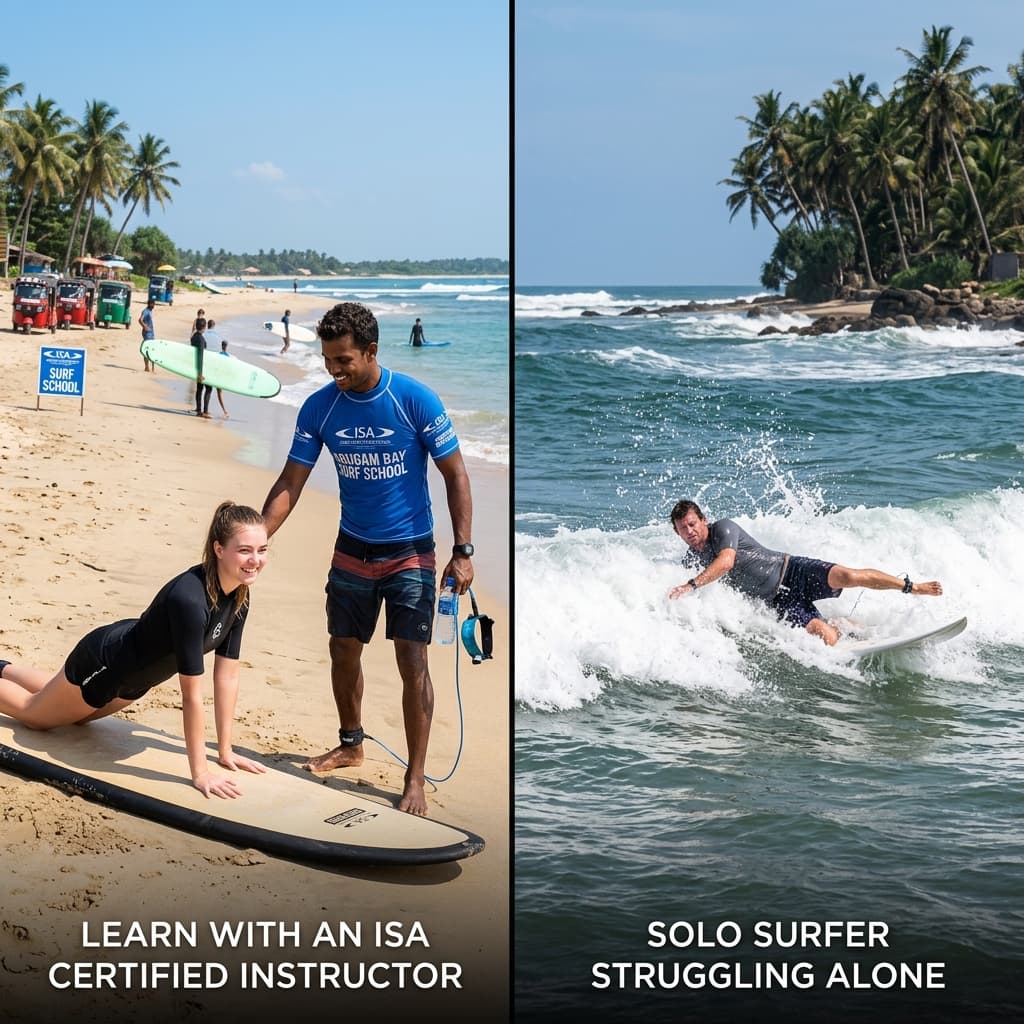
Picture this: you have just arrived in Arugam Bay after a scenic cross-country drive from Colombo. The tropical heat warms your skin, tuk-tuks hum past with multi-colored surfboards strapped to their roofs, and in the distance, clean right-hand waves peel gracefully across a sun-drenched coastline.
Sri Lanka’s East Coast is one of the world's premier surfing meccas. But as you unpack your bags and stroll down Main Street, a pivotal question arises: should I join surf school Arugam Bay, or should I rent a beat-up board for a few hundred rupees and figure it out on my own?
The classic debate between joining an established surf academy and taking the Do-It-Yourself (DIY) route has existed as long as travelers have sought waves. On Instagram and YouTube, DIY surfing looks delightfully easy—grab a board, paddle into turquoise water, and glide effortlessly down the line. However, the ocean rarely adheres to social media reels.
If you are planning your adventure for the upcoming season, deciding whether to invest in an arugam bay surf school 2027 program or attempt diy surfing arugam bay will define your entire holiday. In this in-depth guide, we break down the real pros and cons of both pathways, examine hidden ocean hazards, analyze costs, and help you determine which route guarantees the most waves and the biggest smiles.
The Case for DIY Surfing in Arugam Bay: Honest Pros of Going Solo
Let us be completely fair: the DIY approach has genuine appeal, especially for independent travelers who crave complete freedom. When you choose to surf independently in Arugam Bay, you are in total control of your itinerary.
1. Total Schedule Autonomy
With DIY surfing, there are no alarms set for 5:30 AM unless you want there to be. You do not have to coordinate with a group, meet an instructor at a designated shack, or adhere to a strict lesson timeline. If you danced late at a beach party in town and want to sleep in until 10:00 AM, nobody is waiting on you.
2. Low Upfront Daily Cash Outlay
For shoestring backpackers counting every dollar, renting a soft-top or fiberglass board off the sand can cost as little as $4 to $7 USD (1,200 to 2,000 LKR) for a half-day. On paper, avoiding professional coaching fees seems like an easy way to stretch your travel budget across months rather than weeks.
3. The Romance of Self-Discovery
There is something undeniably romantic about navigating the coastline on your own. You rent a scooter with a side surf-rack, strap your board on, and putter along coastal dirt tracks past grazing water buffaloes and wild peacocks. When you finally paddle out and catch a wave entirely through your own trial and error, the sense of accomplishment is tangible.
4. Perfect for Seasoned Wave Riders
If you already have three or four years of consistent surfing under your belt, understand priority rules inside out, and know how to navigate a shallow reef pass, you do not need someone holding your board. For advanced surfers, exploring the eastern province independently is pure adventure.
However, there is a massive catch: surfing is notoriously counter-intuitive. What works for an experienced surfer usually turns into a frustrating, exhausting ordeal for a beginner or early intermediate going solo.
The Case for Joining an Arugam Bay Surf School: Why Structure Wins
While DIY surfing sounds idyllic in theory, the reality of learning to surf without coaching often looks very different: spending two hours battling through heavy shorebreak, getting caught in unexpected sweep currents, nosediving repeatedly (the dreaded "pearl"), and retiring to the beach with bruised ribs, sunburned shoulders, and zero waves ridden.
Surfing has one of the steepest learning curves of any sport on earth. Joining a reputable surf school arugam bay transforms that steep curve into a smooth, thrilling progression.
1. Daily Sandbank & Wave Selection
Arugam Bay is not just a single beach; it is a complex 30-kilometer cluster of point breaks, sandbars, and reef setups. As detailed in our Arugam Bay surf breaks guide, spots like Baby Point, Peanut Farm, Whiskey Point, Pottuvil Point, and Elephant Rock react very differently depending on the daily swell period, tide height, and shifting morning winds.
A sandbank that offered perfect waist-high peeling waves on Monday might be an onshore, dumping shorebreak by Thursday. When you join a school, local instructors who have watched these breaks for decades assess the conditions at sunrise and transport you directly to the spot where conditions are ideal for your exact skill level.
2. Immediate Biomechanical Feedback
When you try to self-teach, you cannot see what your body is doing. You might not realize that your back foot is placed six inches too far forward, that you are looking down at your toes instead of down the wave face, or that you are pushing up from your knees rather than snapping directly into an athletic stance.
An experienced instructor spots these technical flaws instantly. In our structured beginner surf lessons, a single tip on hip alignment or paddle cadence can save you three weeks of frustrating trial and error.
3. Safety, Ocean Awareness & Confidence
The ocean is a dynamic, living environment. Understanding where rip currents run, how channels work, where submerged boulders lie, and when a clean set is approaching requires trained eyes. Surfing alongside certified surf coaches provides a safety blanket that allows you to relax and focus 100% on riding waves.
4. Tailored Equipment Progression
Renting a board independently often means settling for whatever beat-up equipment a beach kiosk has left over—frequently a waterlogged foam board with warped fins or a narrow shortboard that is completely inappropriate for learning. Professional schools maintain fleets of modern, buoyant beginner boards, progressing you to higher-performance mini-mals and hardboards as your balance and wave-catching abilities evolve.
[!TIP] Fast-Track Your Surfing in 2027
Don't spend your Sri Lanka holiday struggling in the whitewater alone. At Edgeway Surf, our ISA-certified coaches, 4:1 student ratios, and video analysis guarantee you'll be riding clean, unbroken green waves in days—not weeks.
👉 Explore Our Arugam Bay Surf Lessons Here
Comparison Table: Surf School vs. DIY in Arugam Bay
To help you objectively weigh both paths, here is how a structured surf school compares against a DIY trip across the metrics that matter most:
| Feature / Factor | DIY Surfing in Arugam Bay | Arugam Bay Surf School (Edgeway Surf) | The Verdict |
|---|---|---|---|
| Upfront Cost | Low ($5 – $10/day for board rental) | Moderate ($30 – $55/session or camp package) | DIY wins on initial wallet spend |
| Value for Money | Low (few waves caught, high physical burnout) | Extremely High (rapid progression, zero wasted sessions) | Surf School delivers dramatically higher ROI per wave |
| Safety & Medical Risk | High (risk of reef cuts, rips, collisions) | Low (ISA-certified safety protocols, lifeguarding) | Surf School is incomparably safer |
| Learning Speed | Slow (often weeks to catch green waves) | Fast (green waves typically achieved by Day 3 to 5) | Surf School progresses 5x to 10x faster |
| Equipment Quality | Variable (often worn-out or damaged rentals) | Premium (modern soft-tops, epoxy funshapes, Torq boards) | Surf School guarantees dialed equipment |
| Wave Access & Logistics | Difficult (self-navigating dirt roads & tides) | Seamless (daily tuk-tuk transit to the best breaks) | Surf School eliminates all logistical friction |
| Social Community | Independent / Solo | Instant surf tribe, shared meals, group cheers | Surf School / Camp wins for solo travelers |
The Hidden Risks of DIY Surfing in Arugam Bay
Many travelers arrive with the mindset that “surfing is just swimming with a board.” While Arugam Bay is widely considered one of the safest learn-to-surf zones in Asia (read our comprehensive analysis on is Arugam Bay good for beginner surfers), paddling out completely unsupervised carries genuine risks that beginners routinely underestimate.
1. Deceptive Rip Currents and Longshore Sweeps
Points such as Whiskey Point and Elephant Rock are shaped by powerful coastal sandbars. When ocean swells wrap around these points, massive volumes of water must rush back out to sea. This creates fast-moving rip currents along the edges of the rocky outcrops.
To an untrained eye, a rip current often looks like the calmest, smoothest water on the beach—leading naive DIY beginners straight into an offshore conveyor belt. An instructor teaches you how to identify rips, how to use them as free elevators to the lineup, and how to safely exit them without panic.
2. Live Coral Reefs and Submerged Boulders
While beginner spots like Peanut Farm have predominantly sandy bottoms, Arugam Bay’s most famous wave—Main Point—breaks directly over a live, shallow coral reef. Even at intermediate breaks, isolated boulders ("potato rocks") sit hidden just beneath the surface at low tide.
Every year, local clinics treat DIY travelers for deep coral cuts, sea urchin spines, and fin gashes. Knowing the exact entry and exit channels (the “keyholes”) through the reef is knowledge passed down by local instructors that no map can substitute.
3. Hardwired Bad Habits
Surfing relies on muscle memory. When you teach yourself, you inevitably adopt bad mechanical habits:
- The "Stinkbug" Stance: Feet placed parallel with knees splayed outward, locking your hips and preventing turns.
- The Knee Pop-Up: Dragging your knees onto the board before standing, which destabilizes your center of gravity and leads to immediate wipeouts on steep waves.
- Looking Down: Staring at your board rather than scanning down the shoulder of the wave.
Once your brain locks these bad habits into muscle memory, unlearning them takes weeks of frustrating correction. Learning proper mechanics from day one is vastly easier.
4. Lineup Etiquette & Local Friction
Surf lineups operate under strict, unwritten international rules of priority and etiquette. Dropping in on someone already riding a wave, snaking an inside position, or ditching your surfboard when a set wave approaches is dangerous and causes intense friction in crowded lineups.
At a professional surf school, you are taught lineup etiquette, how to paddle wide of the breaking peak, and how to share waves respectfully with both traveling surfers and passionate local wave riders.
What an ISA-Certified Arugam Bay Surf School Actually Teaches You
There is a vast difference between paying a random beach boy to shove you into a wave and enrolling in an International Surfing Association (ISA) certified academy. A true arugam bay surf school 2027 curriculum is a structured educational journey:
[Ocean Theory & Sandbank Mechanics]
       ↓
[Dry-Land Pop-Up & Biomechanical Drills]
       ↓
[Controlled In-Water Whitewater Gliding]
       ↓
[Paddle Technique, Trimming & Acceleration]
       ↓
[Lineup Navigation, Green Wave Catching & Priority]
       ↓
[Video Analysis & Tailored Performance Coaching]
Phase 1: Oceanography & Safety Fundamentals
Before dipping a toe in the water, you learn how waves are generated, how swell period affects wave speed, how to read incoming sets on the horizon, and how to execute proper ocean survival techniques—such as the protective turtle roll and the head-cover surface drill.
Phase 2: Land-Based Biomechanics
You practice the biomechanical steps of the pop-up on dry sand. Instructors adjust your stance, ensure your feet land centered along the stringer, and teach you how to maintain an athletic, shock-absorbing stance with forward hip rotation.
Phase 3: The Green Wave Transition
Once you have mastered catching broken whitewater rollers, coaching pivots to angled take-offs, reading unbroken "green" waves, and generating board speed along the wave face. This is where surfing transforms from a sport into an addiction.
Phase 4: High-Definition Video Coaching
At Edgeway Surf, our advanced coaching modules incorporate professional video analysis. Watching yourself surf on a 4K screen after a morning session is a game-changer. You will visually understand where your weight was balanced, why you missed a section, or how your hands were positioned during your bottom turn. It is the single fastest way to break through a learning plateau.
How Much Does a Surf School in Arugam Bay Cost in 2027?
Budget is always an important consideration. To help you plan your travel finances accurately, here is what you can expect regarding surf school and DIY costs in Arugam Bay for the 2027 season:
Typical Surf School Pricing:
- Single Group Lesson (2 hours): $30 – $40 USD per person (includes board, ISA coach, rash vest, and tuk-tuk transport).
- Private 1-on-1 Lesson: $45 – $60 USD per session (ideal for fast-track progression or intermediate refinement).
- 5-Day Intensive Course: $150 – $190 USD (progressive daily sessions, theory, and feedback).
- All-Inclusive Surf & Stay / Surf Camp (7 Days): $450 – $850+ USD (includes beachfront accommodation, daily coaching, video reviews, all transport, board hire, and breakfast). Check our pricing calculator to customize your dates and package.
The Real Cost of DIY Surfing:
At first glance, DIY looks cheaper:
- Board rental: $6/day × 7 days = $42 USD
- Daily tuk-tuk to distant breaks (Peanut Farm / Whiskey Point): $12 roundtrip × 7 days = $84 USD
- Minor ding repair (inevitable when learning solo): $20 – $40 USD
- Total DIY estimate: ~$146 – $166 USD for the week
When you look at the real math, DIY is hardly cheaper than a comprehensive 5-day structured lesson package! For essentially the same outlay, joining a school gives you certified coaching, dedicated instruction, high-end equipment, and stress-free transport—without the risk of ding penalties or wasted days stuck at flat breaks.
If you are planning an extended stay, pairing your lessons with accommodation through an all-inclusive surf camp in Arugam Bay or a flexible surf and stay package delivers the highest overall savings.
Who Should Go DIY? (An Honest Assessment)
We love surfing in all its forms, and we will never try to sell coaching to someone who genuinely does not need it. You should definitely opt for the DIY route if you meet the following profile:
- You Are an Experienced Independent Surfer: You can reliably paddle outside on 4-to-6-foot days, perform clean bottom turns and cutbacks, and navigate crowded point breaks without endangering others.
- You Understand Swell Charts: You already know how to interpret swell angle, wave period, and wind charts from resources like our Arugam Bay surf season 2027 guide.
- You Are Staying for Months: If you have rented a bungalow for two or three months, you have ample time to figure out the local breaks through slow, leisurely trial and error.
- You Brought Your Own Quiver: Surfers traveling with their own custom boards usually know exactly what conditions match their equipment.
Who Absolutely Needs an Arugam Bay Surf School?
Conversely, if you fall into any of the categories below, attempting to self-teach will likely result in frustration, exhaustion, or injury:
- Complete Beginners: If you have never stood on a surfboard, do not risk your safety or your holiday. A school will have you standing up and smiling on Day 1.
- The "Whitewater-Stuck" Surfer: If you have tried surfing a few times on previous holidays but find yourself stuck in the waist-deep white foam, structured coaching is what bridges the gap to real green waves.
- Intermediates Stuck on a Plateau: Surfers who can catch green waves but struggle to trim left or right, generate down-the-line speed, or perform clean turns benefit immensely from private surf lessons with focused video analysis.
- Vacationers with Limited Time: If you only have one or two weeks in Sri Lanka, you cannot afford to waste four days learning why your pop-up fails. A school ensures maximum wave count from your very first morning.
- Solo Travelers: Surfing with a school or camp provides an instant circle of travel companions to share sunset coconuts and explore the top things to do in Arugam Bay.
Why Edgeway Surf is the Best School in Arugam Bay for 2027
If you have decided that structured instruction is the smart choice for your Sri Lankan surf trip, choosing the right school is your next step. Here is why Edgeway Surf has earned its reputation as the benchmark surf school on the East Coast:
1. 100% ISA-Certified Local Instructors
All our head coaches hold recognized International Surfing Association certifications and formal ocean rescue credentials. Born and raised on the shores of Arugam Bay, they combine world-class sports coaching theory with an innate, lifelong understanding of local wave dynamics.
2. Strict 4:1 Student-to-Instructor Ratios
Many budget surf schools herd 8 to 10 beginners into the water with a single instructor, leaving students unattended in the impact zone. At Edgeway Surf, we cap our group sessions at a strict 4:1 student-to-coach ratio, ensuring you receive constant personal feedback, safety monitoring, and tailored tips on every single wave you paddle for.
3. Integrated Video Coaching
We do not believe in guessing. Our dedicated media team captures high-definition footage of your sessions, followed by comfortable review clinics back at our lounge. Seeing your stance on video is an eye-opening experience that accelerates progression tenfold.
4. Seamless Surf Logistics
Forget haggling with tuk-tuk drivers on dusty road corners. Every lesson includes private tuk-tuk transit directly from our school base to the break that is working best that morning. When conditions favor distant sandbars, we get you there first before the crowds arrive.
5. Complete Sri Lanka Adventures
Surfing is just the beginning. We also organize unforgettable Surf & Safari packages into nearby Kumana National Park (home to wild elephants, leopards, and migratory birds) and provide reliable airport taxi transfers straight from Colombo Bandaranaike International Airport (CMB) to our camp doors. If you are planning your journey across the island, check our detailed travel breakdown on how to get from Colombo to Arugam Bay.
Frequently Asked Questions
Is it safe to surf in Arugam Bay without a surf school?
It depends entirely on your experience. For intermediate and advanced surfers who understand reef breaks, rip currents, and lineup etiquette, independent surfing is common and enjoyable. However, complete beginners should never paddle out solo in Arugam Bay; hidden boulders, powerful longshore sweeps, and shallow reef sections can quickly turn a casual session into a hazardous situation without experienced local guidance.
How many lessons do I need before surfing on my own in Arugam Bay?
Most beginners require approximately 5 to 7 structured lessons before they have the paddle stamina, ocean reading ability, and board control necessary to safely catch small green waves without supervision. Enrolling in an intensive 5-to-7-day surf camp guide program condenses this learning curve significantly.
Can intermediate surfers benefit from Arugam Bay surf school coaching?
Yes, absolutely. In fact, intermediate surfers often see the most dramatic leaps in ability through professional coaching. Breaking through the common intermediate plateau—such as mastering backhand bottom turns, generating speed in weak sections, or executing clean cutbacks—is made dramatically easier through frame-by-frame video analysis and technical drills guided by our senior coaches.
Does Edgeway Surf School offer lessons for all skill levels?
Yes. Edgeway Surf provides comprehensive instruction across all tiers of surfing. We host tailored beginner surf lessons, intermediate progression workshops, private one-on-one coaching, and week-long immersive surf camp programs complete with board rentals and safari excursions.
The Verdict: School vs. DIY for 2027?
So, what is the ultimate verdict for 2027?
If you are an advanced surfer with a quiver of shortboards and a deep understanding of ocean swell dynamics, going the DIY route across Sri Lanka’s eastern province is an unforgettable adventure.
However, if your goal is to learn quickly, stay safe, catch dozens of waves every morning, and avoid months of bad habits, joining an established arugam bay surf school 2027 like Edgeway Surf is the smartest investment you can make for your holiday. You will save energy, eliminate logistical stress, meet lifelong friends, and experience the pure euphoria of riding the best waves of your life.
Ready to Catch Your Dream Wave in Arugam Bay?
Don’t leave your surf holiday to chance. Whether you are stepping on a board for the very first time or looking to refine your turns on legendary right-hand point breaks, the team at Edgeway Surf School is ready to welcome you to the lineup.
- 🏄♂️ Browse our lesson options: Explore our Arugam Bay Surf Lessons or book Private Surf Coaching.
- 🌴 Immerse yourself: Check out our all-inclusive Arugam Bay Surf Camp Packages and Surf & Stay Specials.
- 💬 Have questions? Reach out directly through our Contact Page to check availability or custom tailor your 2027 surf trip!
Ready to catch some waves? Book a beginner surf course or surf lesson in Arugam Bay at Edgeway Surf School today!
Frequently Asked Questions
Is it safe to surf in Arugam Bay without a surf school?
It depends on your experience. Beginners should never attempt Arugam Bay waves solo — rip currents and reef sections can be dangerous without proper guidance.
How many lessons do I need before surfing on my own in Arugam Bay?
Most beginners need 5-7 lessons to confidently surf small waves independently. A structured 3-5 day camp accelerates this significantly.
Can intermediate surfers benefit from Arugam Bay surf school coaching?
Absolutely. Even experienced surfers plateau without professional video analysis and targeted coaching on specific weaknesses.
Does Edgeway Surf School offer lessons for all skill levels?
Yes. We offer beginner, intermediate, and advanced coaching, private 1-on-1 sessions, and full 7-day progressive camp programs.